CREW
Flaviano Raschietti, Leopoldo Morbin, Nicola Cracco and Mauro Forlani construct artworks from coloured paper and glue, following numerical sequences, combinatorial rules and formal constraints.
Selected works from Linus, Bach, Beatles. L’Arte Matematica: istruzioni per l’uso, curated by Giovanna Grossato, 2026.
Visit the official CREW website →
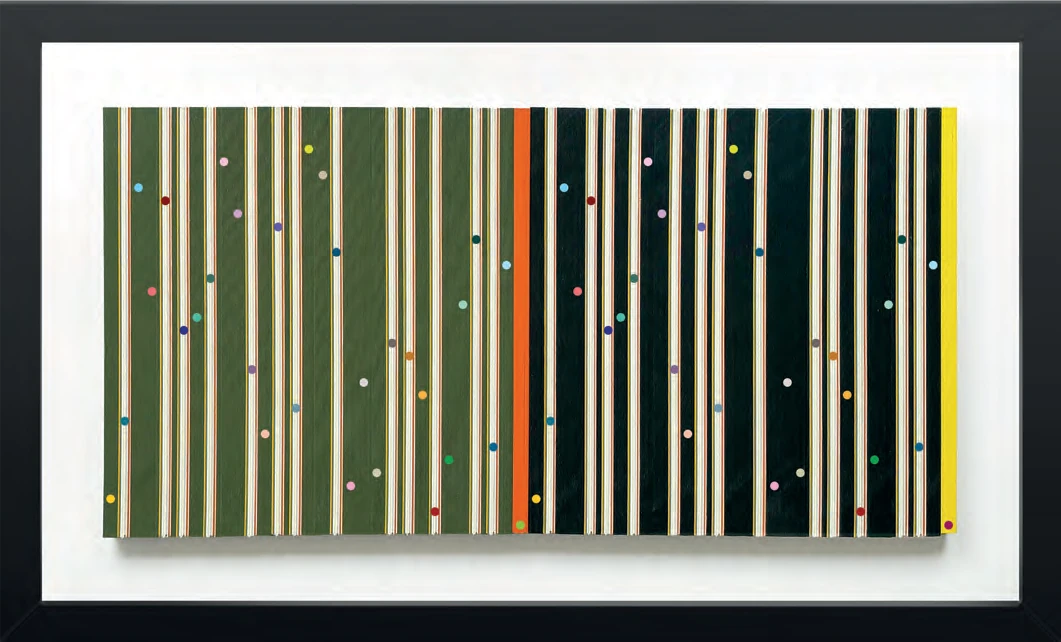
Linus 60, Sally 30
View artwork and explanation →
About this work
The composition takes its rule from Nathaniel Hellerstein’s Linus sequence, a binary sequence built one symbol at a time by comparing possible repetitions at its end. The companion Sally sequence records the length of the longer repetition avoided at each step. CREW translates these numerical constraints into a rhythm of coloured strips: apparent repetitions and changes arise from a rule rather than from a random arrangement. The catalogue connects this process to Linus’s attempt to break predictable patterns in a Peanuts true-or-false test. Paper, colour and spacing give a visible form to the tension between a fixed procedure and a complex result.
Starting with 01001101, the catalogue compares two possible continuations. Adding 0 produces a repeated final block of two digits; adding 1 produces a repeated final block of three. The shorter repetition is selected, so the next digit is 0. This example explains how the sequence uses its own preceding digits to determine what follows.
In the artwork, the strips produce a sequence of intervals, contrasts and apparent returns. The connection with the Peanuts character is therefore more than a title: it links an attempt to evade predictable answers to a construction whose complexity comes from a precise procedure. CREW’s use of paper and glue gives this abstract process a physical surface that the viewer can examine.
CREW · 2026
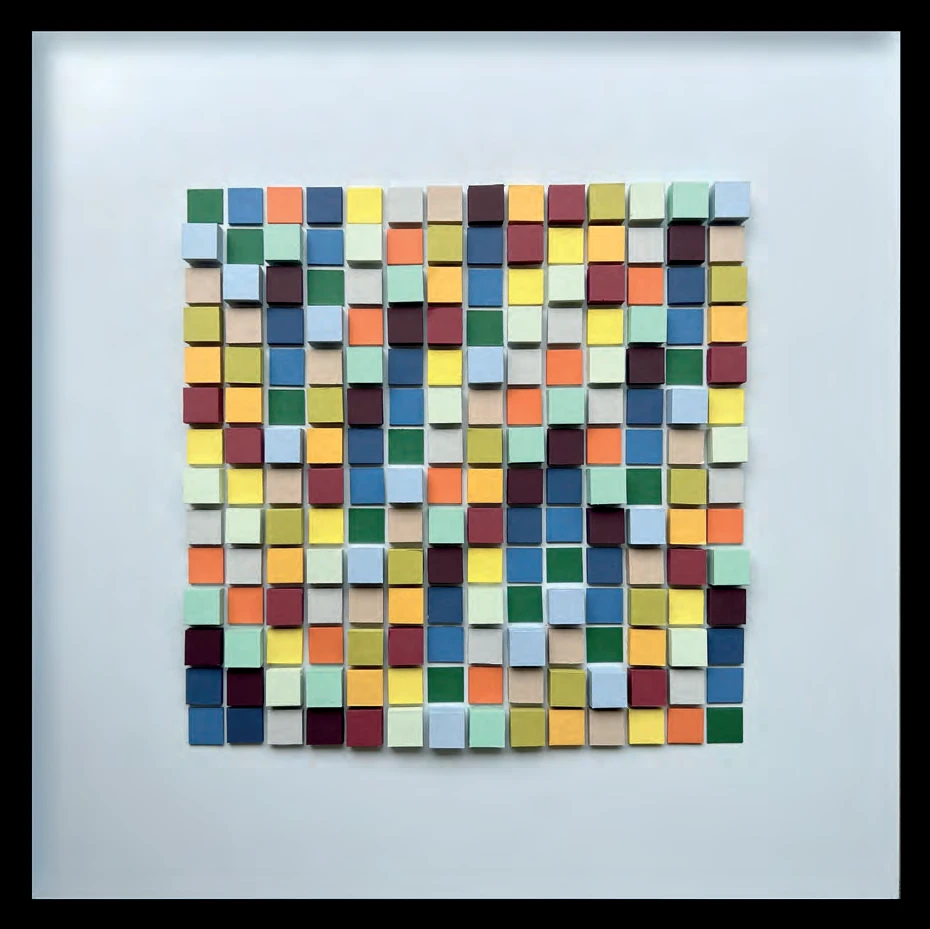
Bartlebooth
View artwork and explanation →
About this work
The catalogue identifies the rule of this coloured modular composition as the Queneau number Q14. Its grid belongs to CREW’s broader exploration of mathematical constraints: a chosen rule governs the organisation of discrete elements, while colour and physical construction make the resulting structure visible. The catalogue places this approach in the tradition of Oulipo, the literary workshop founded by Raymond Queneau and François Le Lionnais. In that tradition, formal restrictions generate possibilities for composition. Here the relationship between the coloured units and the whole can be read as a visual counterpart to writing organised by a numerical scheme.
The relevant literary background is the Oulipian idea of a deliberately chosen constraint. The catalogue traces it back to the sestina, in which recurring end-words change position under a fixed permutation, and forward to Queneau’s poems assembled from interchangeable lines. These examples show how organising a finite set of elements can produce a large space of possible works.
The relief-like grid makes that relationship tangible. Each coloured unit is distinct, yet it participates in a larger order; variation appears through the relations between units rather than through an unrestricted arrangement. Seen in this context, the work invites attention to both the individual module and the whole pattern. The rule supplies the framework; paper, colour, spacing and depth supply the perceptible form.
CREW · 2026
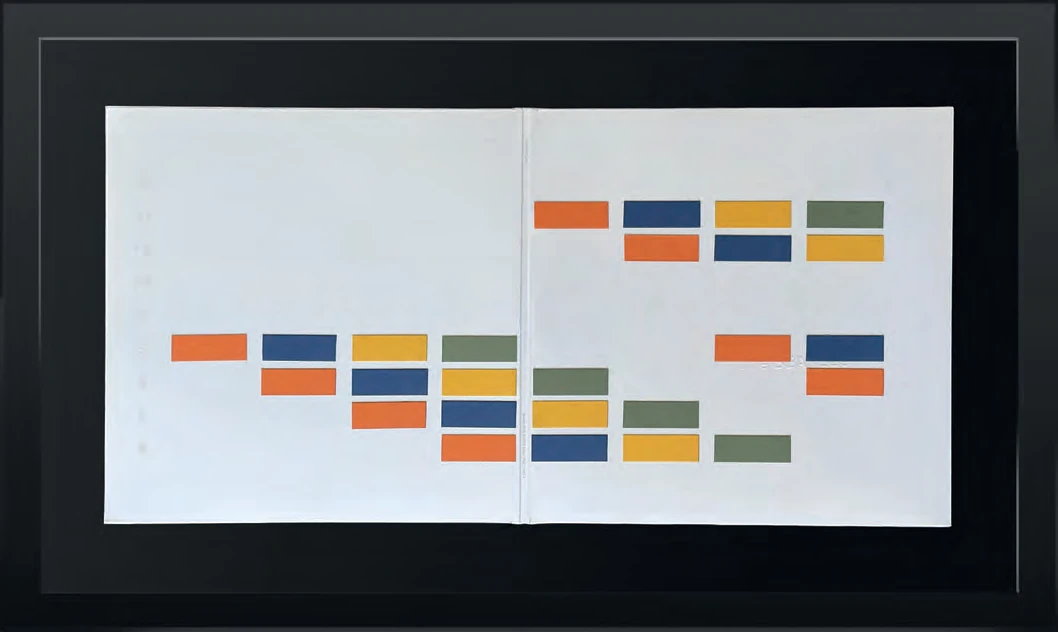
Bach
View artwork and explanation →
About this work
This work uses combinations of eight colours taken two at a time. In mathematical terms, eight distinct colours give 28 unordered pairs when repetition is excluded. The catalogue connects CREW’s method to Bach’s contrapuntal practice: musical themes can be inverted, exchanged between voices and combined under precise constraints. The artwork translates the principle of composing within a rule into coloured paper elements. It does not transcribe a particular score; its connection to Bach lies in the relationship between a limited set of materials, their possible combinations and the structure of the completed composition.
There are 8 choices for the first colour and 7 for a different second colour. Since a pair is counted only once, dividing 8 × 7 by 2 gives 28 combinations. This distinction matters: exchanging the order of a pair does not create a new combination, although the placement of its colours can still affect the visual composition.
The catalogue discusses The Art of Fugue as an exploration of what a subject can generate through inversion, changes of scale and interaction between voices. Its analogy with CREW concerns the productive role of constraint. The colours form a limited vocabulary, comparable in this respect to musical material that can be reorganised. The viewer can follow recurring colours and changing partnerships while also attending to the arrangement of the paper elements.
CREW · 2023
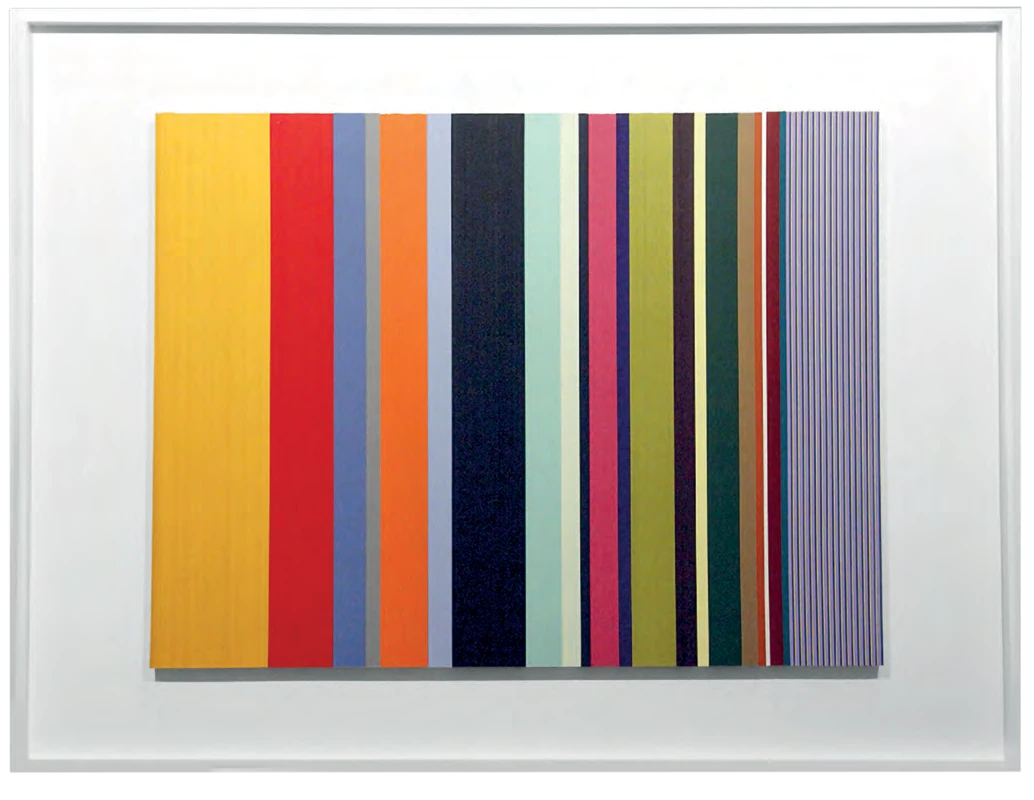
Il grande C
View artwork and explanation →
About this work
The coloured structure follows the Collatz sequence starting at 152. The rule divides an even number by two and replaces an odd number with three times that number plus one; the procedure is then repeated. From 152, the sequence reaches the cycle 4, 2, 1. CREW uses this arithmetic process as a constraint for a physical composition, making an iterative numerical structure visible through coloured strips. The catalogue presents the sequence in its section ‘Carta, Colla, Collatz’. The claim that every positive starting value eventually reaches 1 is the Collatz conjecture, not a proven theorem; reaching 1 in this particular case does not establish it for all numbers.
The first steps are 152 → 76 → 38 → 19 → 58 → 29 → 88. Repeated division decreases an even value, while applying 3n + 1 to an odd value increases it before the next division. This alternation explains why the path need not descend steadily even when it eventually reaches 1.
The arithmetic trajectory becomes a starting point for looking at the work’s narrow and broad coloured bands and their successive contrasts. The catalogue’s larger argument is that a sequence can be given a body: a numerical procedure becomes paper, spacing and a surface with material depth. The image offers a way to encounter the structure visually while the accompanying rule explains what determines its construction.
CREW · 2024
Cicloide
View artwork and explanation →
About this work
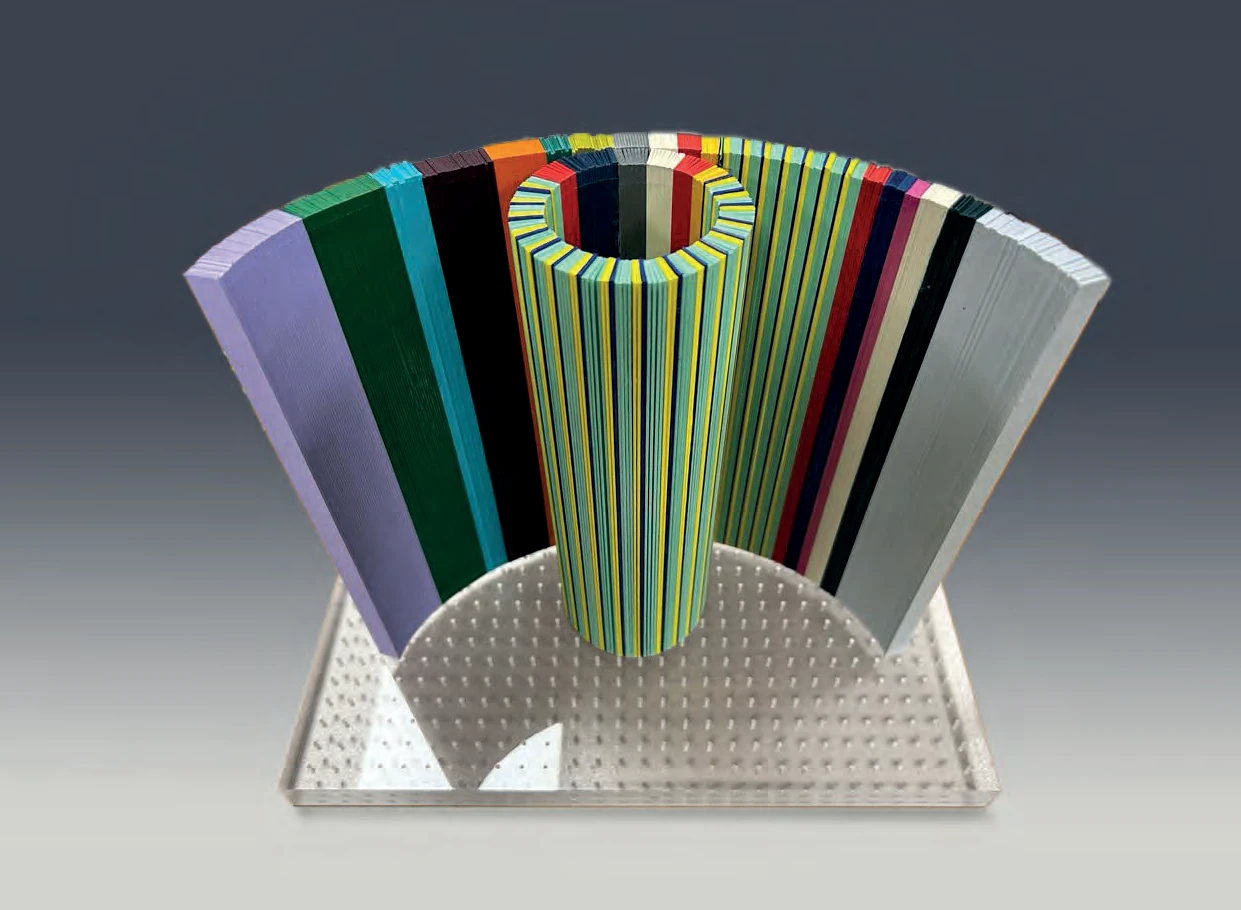
The catalogue associates this paper sculpture with two mathematical structures: a cycloid curve and the Collatz sequence starting at 40. A cycloid is the path traced by a point on a circle rolling along a straight line. The arithmetic sequence 40, 20, 10, 5, 16, 8, 4, 2, 1 supplies a second constraint. CREW brings geometry and numerical iteration into a construction that occupies space. This follows the catalogue’s account of the transition from flat compositions to sculptures: paper is lifted and bent so that mathematical organisation becomes volume, shadow and a form viewed from different directions.
The Collatz path here is short enough to follow completely. An initial chain of divisions takes 40 to 5. The odd value 5 then becomes 16, followed by 8, 4, 2 and 1. Geometry and iteration therefore provide different kinds of organisation: one concerns a curve produced by motion, the other concerns a series of numerical transformations.
The catalogue describes CREW’s move into three dimensions as an extension of the same constraints used in its flat works. Paper gains curvature and occupies a volume; gaps, shadows and changes of viewing angle become part of the experience. In Cicloide, the coloured elements can be read both as a succession of individual parts and as a spatial whole. The sculpture makes the relationship between rule and material form visible beyond the plane of a framed image.
CREW · 2023
L’Escalina – Arnaut, Dante, Queneau
View artwork and explanation →
About this work
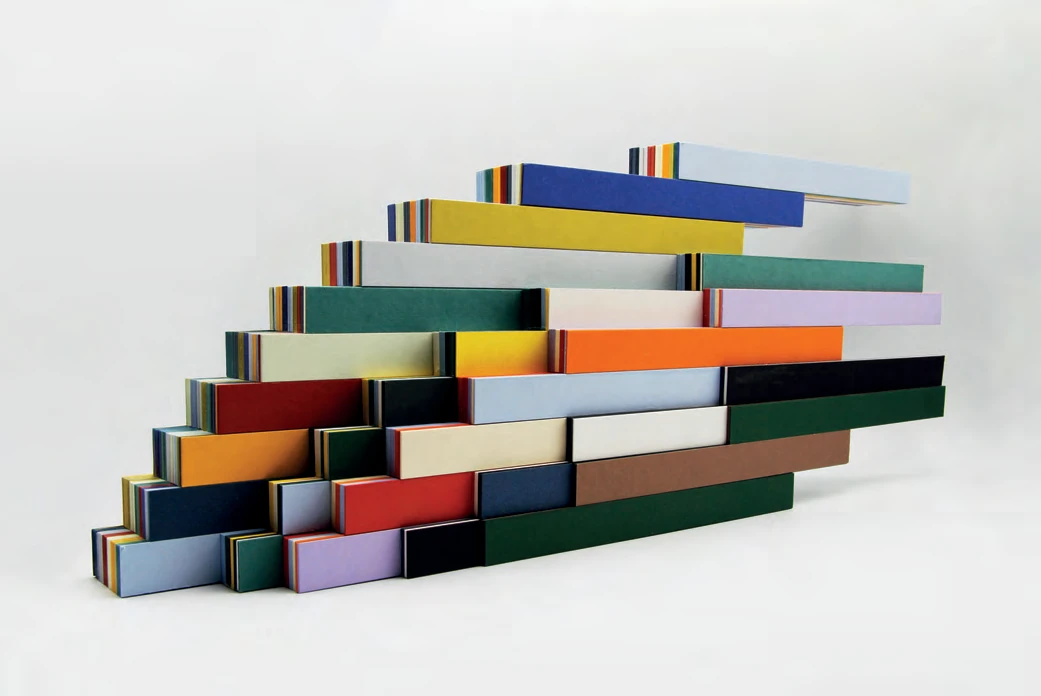
This staircase-shaped sculpture is organised by the first Queneau numbers. Its title links Arnaut Daniel, Dante and Raymond Queneau. The catalogue follows that connection through the sestina: six end-words change position according to a fixed permutation across six stanzas. Arnaut’s poetic invention and Dante’s encounter with him in Purgatorio provide a literary background to Queneau’s later exploration of formal constraints. The staircase turns that connection into a physical object. The catalogue interprets climbing as an image of the effort involved in accepting a rule and working within it: the constraint provides the structure from which the artwork develops.
The sestina is a particularly concrete meeting point between language and mathematics. Its six recurring end-words remain the same, but the permutation changes their position from stanza to stanza. The procedure preserves the elements while reorganising their relations. In Queneau’s later literary experiments, the comparable question is what a chosen formal scheme allows a writer to construct.
CREW gives that idea an ascending, stepped shape. Its coloured elements build a progression that can be followed across the sculpture, translating the catalogue’s theme of constraint into a form with height, depth and direction. The reference to Dante’s encounter with Arnaut in Purgatorio places the staircase within a longer literary history. Mathematical organisation, poetic craft and the physical effort of ascent converge in one object.
CREW · 2024