Linus 60, Sally 30
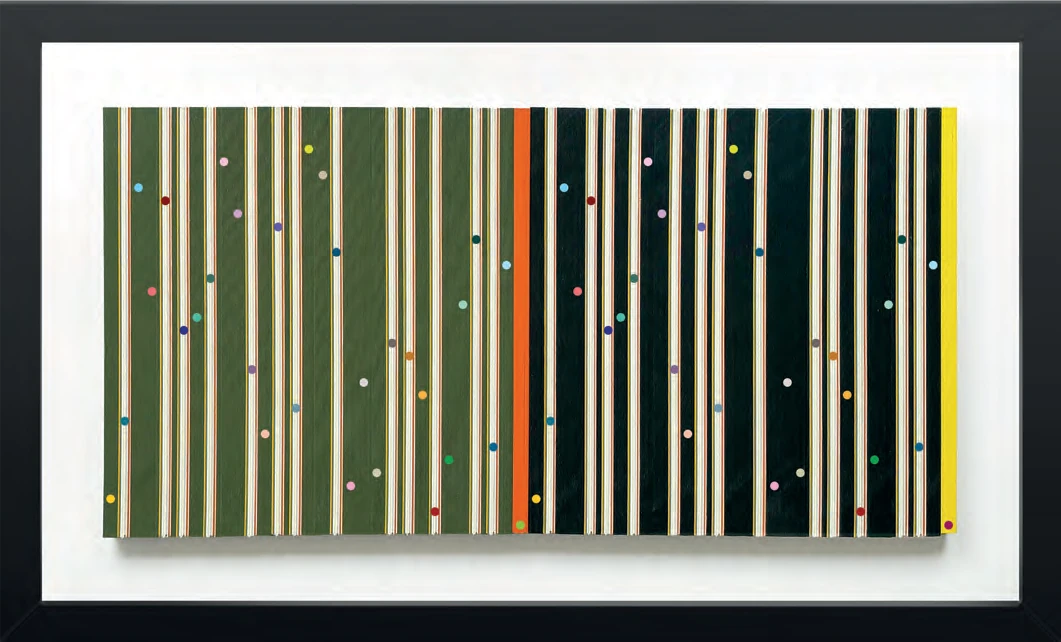
The composition takes its rule from Nathaniel Hellerstein’s Linus sequence, a binary sequence built one symbol at a time by comparing possible repetitions at its end. The companion Sally sequence records the length of the longer repetition avoided at each step. CREW translates these numerical constraints into a rhythm of coloured strips: apparent repetitions and changes arise from a rule rather than from a random arrangement. The catalogue connects this process to Linus’s attempt to break predictable patterns in a Peanuts true-or-false test. Paper, colour and spacing give a visible form to the tension between a fixed procedure and a complex result.
Starting with 01001101, the catalogue compares two possible continuations. Adding 0 produces a repeated final block of two digits; adding 1 produces a repeated final block of three. The shorter repetition is selected, so the next digit is 0. This example explains how the sequence uses its own preceding digits to determine what follows.
In the artwork, the strips produce a sequence of intervals, contrasts and apparent returns. The connection with the Peanuts character is therefore more than a title: it links an attempt to evade predictable answers to a construction whose complexity comes from a precise procedure. CREW’s use of paper and glue gives this abstract process a physical surface that the viewer can examine.
Source: Linus, Bach, Beatles. L’Arte Matematica: istruzioni per l’uso, 2026. CREW 442, catalogue page 9. Curated by Giovanna Grossato.
CREW: Flaviano Raschietti, Leopoldo Morbin, Nicola Cracco and Mauro Forlani.