Bartlebooth
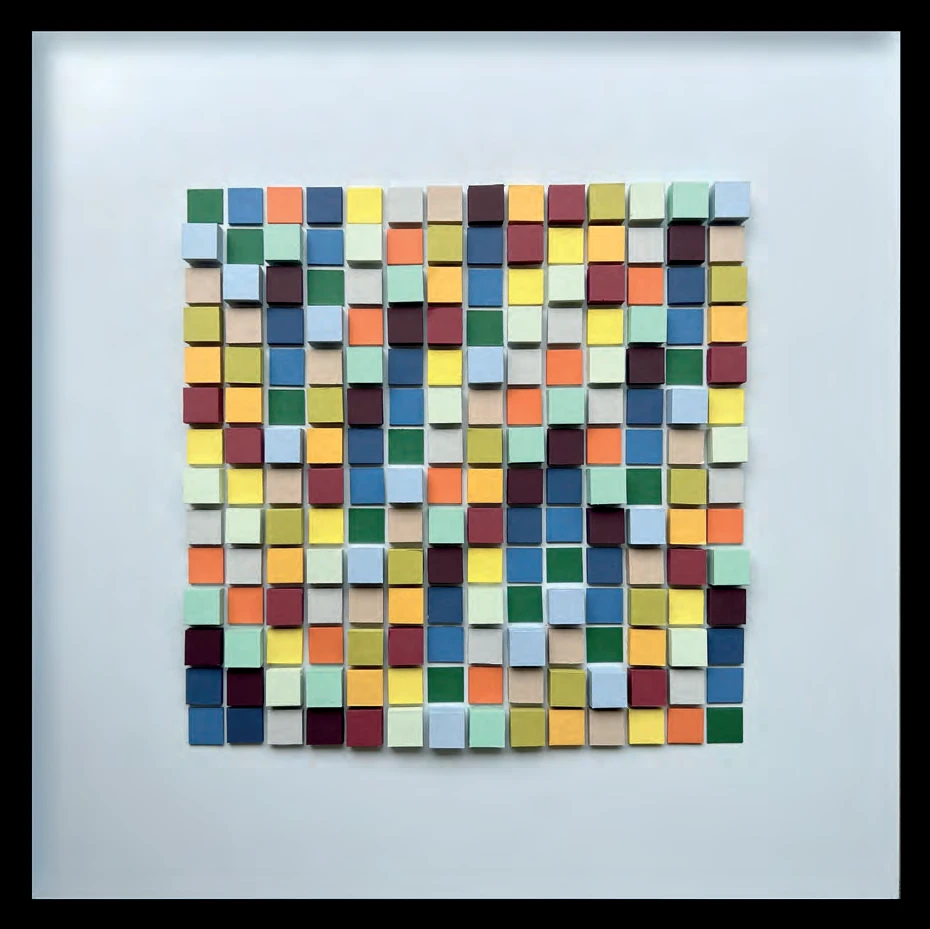
The catalogue identifies the rule of this coloured modular composition as the Queneau number Q14. Its grid belongs to CREW’s broader exploration of mathematical constraints: a chosen rule governs the organisation of discrete elements, while colour and physical construction make the resulting structure visible. The catalogue places this approach in the tradition of Oulipo, the literary workshop founded by Raymond Queneau and François Le Lionnais. In that tradition, formal restrictions generate possibilities for composition. Here the relationship between the coloured units and the whole can be read as a visual counterpart to writing organised by a numerical scheme.
The relevant literary background is the Oulipian idea of a deliberately chosen constraint. The catalogue traces it back to the sestina, in which recurring end-words change position under a fixed permutation, and forward to Queneau’s poems assembled from interchangeable lines. These examples show how organising a finite set of elements can produce a large space of possible works.
The relief-like grid makes that relationship tangible. Each coloured unit is distinct, yet it participates in a larger order; variation appears through the relations between units rather than through an unrestricted arrangement. Seen in this context, the work invites attention to both the individual module and the whole pattern. The rule supplies the framework; paper, colour, spacing and depth supply the perceptible form.
Source: Linus, Bach, Beatles. L’Arte Matematica: istruzioni per l’uso, 2026. CREW 460, catalogue page 11. Curated by Giovanna Grossato.
CREW: Flaviano Raschietti, Leopoldo Morbin, Nicola Cracco and Mauro Forlani.