Cicloide
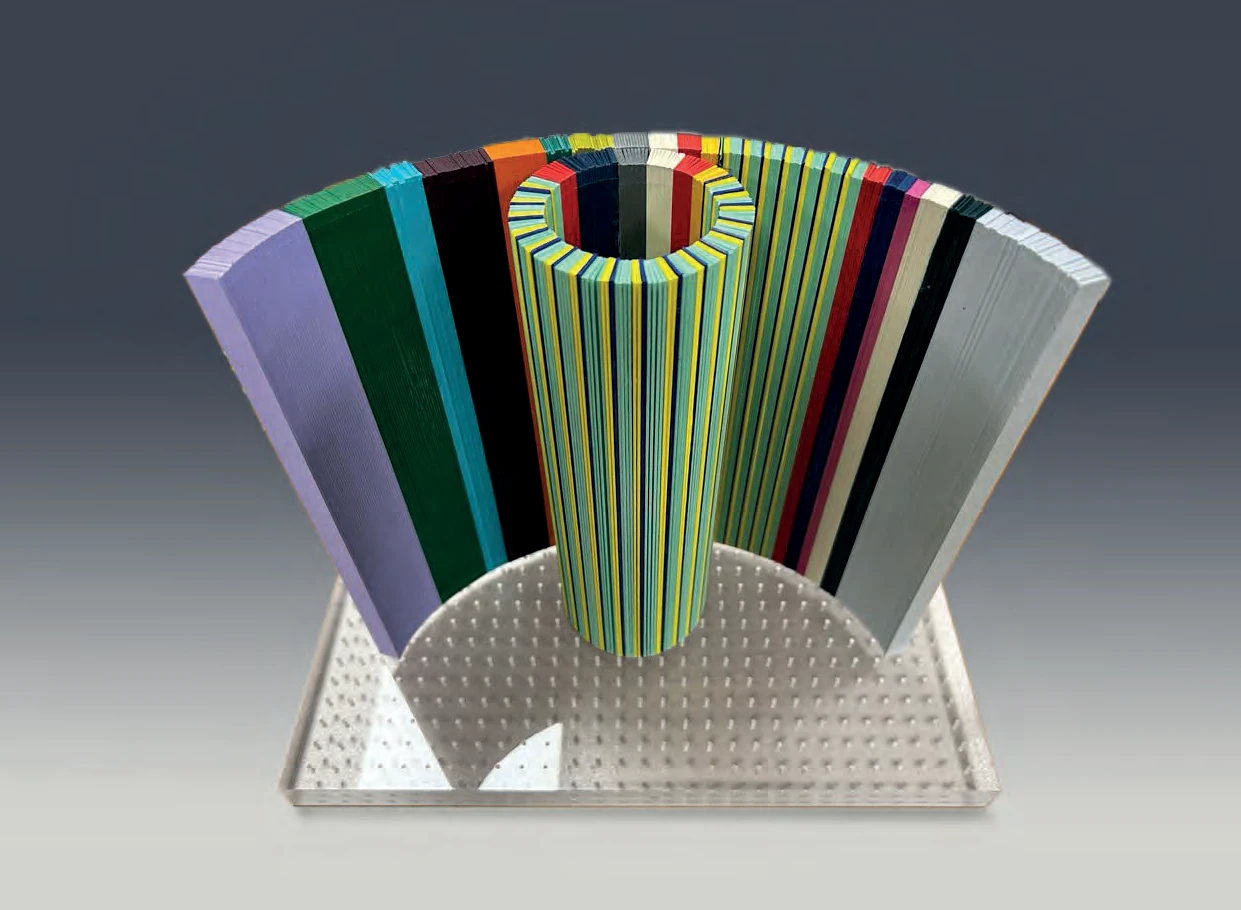
The catalogue associates this paper sculpture with two mathematical structures: a cycloid curve and the Collatz sequence starting at 40. A cycloid is the path traced by a point on a circle rolling along a straight line. The arithmetic sequence 40, 20, 10, 5, 16, 8, 4, 2, 1 supplies a second constraint. CREW brings geometry and numerical iteration into a construction that occupies space. This follows the catalogue’s account of the transition from flat compositions to sculptures: paper is lifted and bent so that mathematical organisation becomes volume, shadow and a form viewed from different directions.
The Collatz path here is short enough to follow completely. An initial chain of divisions takes 40 to 5. The odd value 5 then becomes 16, followed by 8, 4, 2 and 1. Geometry and iteration therefore provide different kinds of organisation: one concerns a curve produced by motion, the other concerns a series of numerical transformations.
The catalogue describes CREW’s move into three dimensions as an extension of the same constraints used in its flat works. Paper gains curvature and occupies a volume; gaps, shadows and changes of viewing angle become part of the experience. In Cicloide, the coloured elements can be read both as a succession of individual parts and as a spatial whole. The sculpture makes the relationship between rule and material form visible beyond the plane of a framed image.
Source: Linus, Bach, Beatles. L’Arte Matematica: istruzioni per l’uso, 2026. CREW 110, catalogue page 49. Curated by Giovanna Grossato.
CREW: Flaviano Raschietti, Leopoldo Morbin, Nicola Cracco and Mauro Forlani.