Il grande C
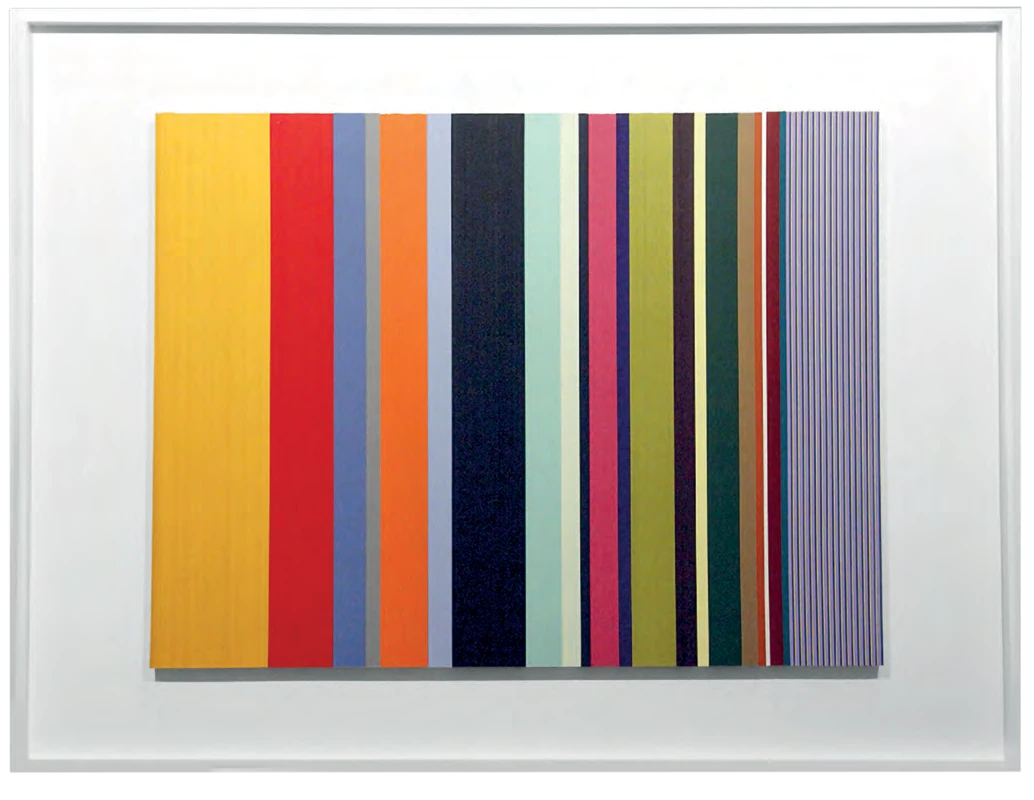
The coloured structure follows the Collatz sequence starting at 152. The rule divides an even number by two and replaces an odd number with three times that number plus one; the procedure is then repeated. From 152, the sequence reaches the cycle 4, 2, 1. CREW uses this arithmetic process as a constraint for a physical composition, making an iterative numerical structure visible through coloured strips. The catalogue presents the sequence in its section ‘Carta, Colla, Collatz’. The claim that every positive starting value eventually reaches 1 is the Collatz conjecture, not a proven theorem; reaching 1 in this particular case does not establish it for all numbers.
The first steps are 152 → 76 → 38 → 19 → 58 → 29 → 88. Repeated division decreases an even value, while applying 3n + 1 to an odd value increases it before the next division. This alternation explains why the path need not descend steadily even when it eventually reaches 1.
The arithmetic trajectory becomes a starting point for looking at the work’s narrow and broad coloured bands and their successive contrasts. The catalogue’s larger argument is that a sequence can be given a body: a numerical procedure becomes paper, spacing and a surface with material depth. The image offers a way to encounter the structure visually while the accompanying rule explains what determines its construction.
Source: Linus, Bach, Beatles. L’Arte Matematica: istruzioni per l’uso, 2026. CREW 210, catalogue page 33. Curated by Giovanna Grossato.
CREW: Flaviano Raschietti, Leopoldo Morbin, Nicola Cracco and Mauro Forlani.