Ideal-Gas Processes — Work, Heat and State Functions
By Prof. Marco Ruzzi.
Theoretical background
The sign convention is ΔU=q+w: heat absorbed and work done on the system are positive. For an ideal gas, pV=nRT and U depends only on temperature. An isothermal change therefore gives ΔU=0.
At constant external pressure:
\[w=-p_0(V_f-V_i).\]For a reversible isothermal ideal-gas process:
\[w=-nRT\ln\left(\frac{V_f}{V_i}\right).\]Between ideal-gas states at the same temperature:
\[\Delta S=nR\ln\left(\frac{V_f}{V_i}\right).\]Exercise 1 — Irreversible isothermal expansion
Determine the relation between pressure–volume work, absorbed heat and internal-energy change during an irreversible isothermal expansion of an ideal gas. Compare it with the reversible case.
Solution
Work is not a state function. It depends on the path, that is, on how the transformation is performed.
For an ideal gas U depends only on temperature. During an isothermal expansion both T and U remain constant. The First Law also applies to irreversible transformations:
\[\Delta U=q+w=0.\] \[w=-q.\]The change in internal energy is zero, whereas expansion against a nonzero opposing pressure involves negative work and positive absorbed heat.
Observations
For the ideal-gas model, U is a function of T alone, so an isothermal transformation leaves it unchanged. The decrease in internal energy that expansion work would produce by itself is compensated by the increase due to heat absorption:
\[\Delta U=q+w=0.\]In particular, for a reversible isothermal expansion:
\[w=-q=-nRT\ln\left(\frac{V_f}{V_i}\right),\qquad V_f>V_i.\]The work is negative because the system does work on its surroundings. Without heat absorption, that work would reduce its internal energy. The heat is positive because it is absorbed: without the work done by the system, it would increase its internal energy. The logarithmic work expression must not be used for an arbitrary irreversible path.
Exercise 3 — Work at constant external pressure
Discuss pressure–volume work for a real gas expanding against constant external pressure, the heat–work balance in an isothermal ideal-gas expansion, and the conditions needed to write the expansion work of a gas produced by a reaction as w=−nRT.
Solution
Deriving the work expression at constant external pressure does not require reversibility:
\[w=-\int_{V_i}^{V_f}p_0\,dV=-p_0\Delta V.\]For an isothermal ideal-gas expansion, U=U(T); constant T therefore gives ΔU=0 and q+w=0.
To derive w=−nRT, consider expansion against constant p₀, with the initial gas volume negligible and the final gas pressure equal to p₀, the derivation is:
\[w=-p_0(V_f-V_i)\simeq-p_0V_f.\]Using the ideal-gas equation pfVf=nRT:
\[w\simeq-p_0\frac{nRT}{p_f}=-nRT.\]The ideal equation of state is essential to that last substitution. It cannot be applied as stated to a real gas.
Problem — Compression along three paths
A compression takes 100 mol of H₂, treated as an ideal gas, from (p₁, 4 m³, 300 K) to (p₂, 2 m³, 300 K).
- Determine the total work done on the gas for: (a) an isobaric process followed by an isochoric process; (b) an isothermal process; (c) an isochoric process followed by an isobaric process.
- Determine ΔU and ΔS in each case.
- Discuss the results in terms of state functions.
1. Work along the paths
The three paths are shown in the p–V diagram. They are treated as reversible paths for the work calculations.
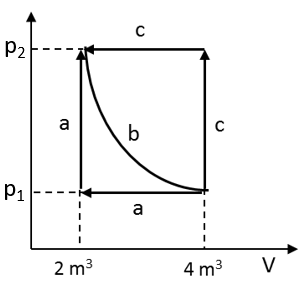
View the diagram at full size.
V₁=2V₂ and V₂<V₁. All three processes are compressions, so positive work is expected: it is done on the system.
\[p_1=\frac{nRT}{V_1}.\] \[p_2=\frac{nRT}{V_2}=\frac{2nRT}{V_1}=2p_1.\] \[nRT=(100)(8.314)(300)=249.420\times10^3\ \mathrm{J}.\]Path (a). The isochoric stage contributes no work:
\[w_a=-p_1(V_2-V_1)+0.\] \[w_a=-nRT\left(\frac{V_2}{V_1}-1\right).\] \[w_a=+124.71\times10^3\ \mathrm{J}.\]Path (b). For the reversible isothermal compression:
\[w_b=-nRT\ln\left(\frac{V_2}{V_1}\right).\] \[w_b=-(249.420\times10^3)\ln(1/2)\ \mathrm{J}.\] \[w_b\simeq+172.885\times10^3\ \mathrm{J}.\]Path (c). The first, isochoric stage contributes no work; the compression takes place at p₂:
\[w_c=0-p_2(V_2-V_1)=2w_a.\] \[w_c=+249.42\times10^3\ \mathrm{J}.\]2. Internal energy and entropy
U and S are state functions, so their changes are the same for all three paths. They can be evaluated along the isothermal path:
\[\Delta U=0.\] \[\Delta S=nR\ln\left(\frac{V_2}{V_1}\right).\] \[\Delta S=(100)(8.314)\ln(1/2)\ \mathrm{J\,K^{-1}}.\] \[\Delta S\simeq-576.28\ \mathrm{J\,K^{-1}}.\]3. State functions and path dependence
ΔU and ΔS can be calculated without knowing the actual path, because the endpoints determine them:
\[\Delta U_a=\Delta U_b=\Delta U_c.\] \[\Delta S_a=\Delta S_b=\Delta S_c.\]Work is not a state function: wₐ, wb and wc differ. For reversible processes its magnitude is the area under the p(V) curve. The diagram therefore gives:
\[w_a<w_b<w_c.\]